
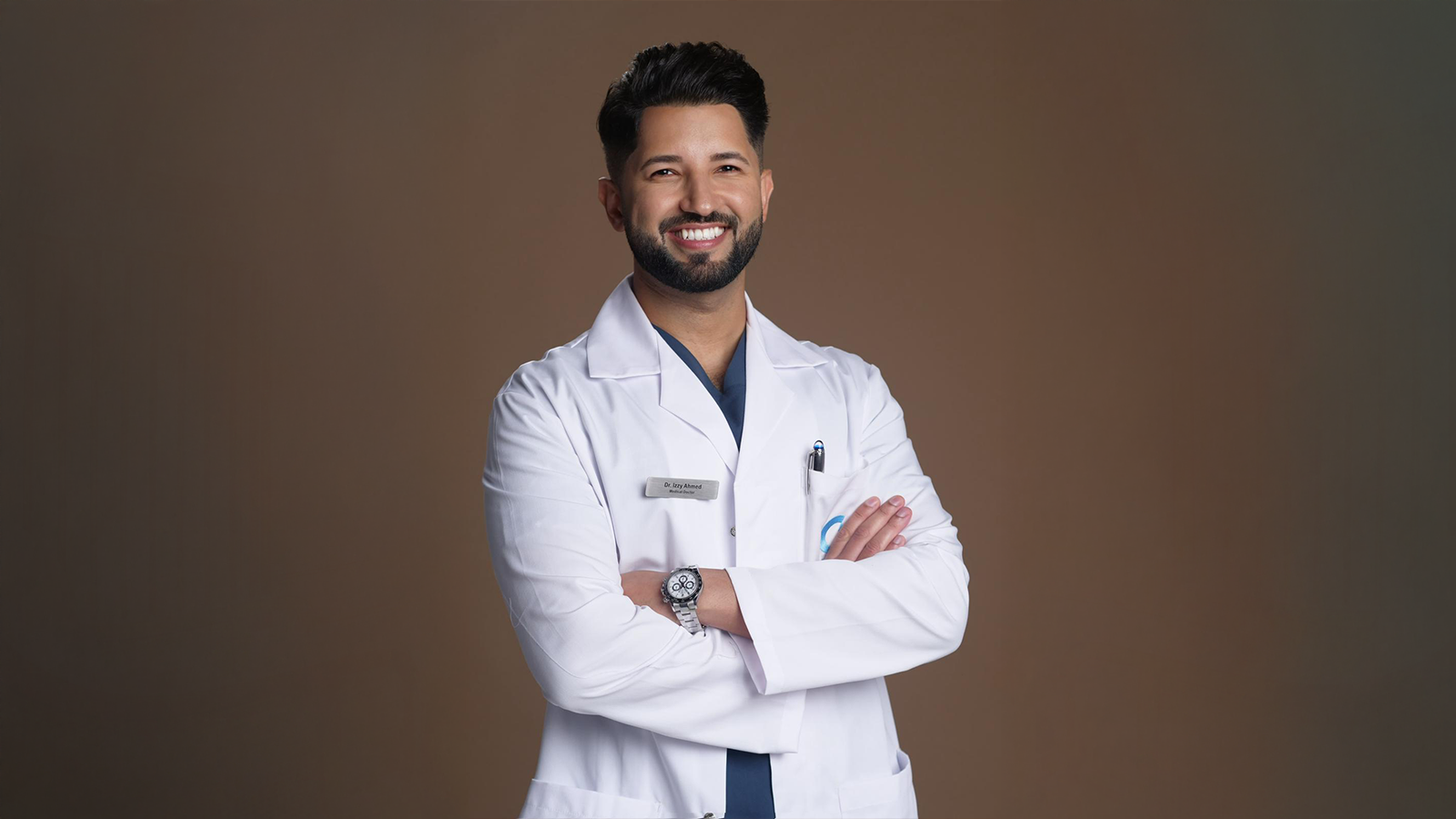
Future-Proof Your Life: Dr. Izzy on Tech, Tracking & Optimising Every Aspect of Wellness

Dr. Izzy, Lead Medical Doctor at Sigma Clinic, is redefining what it means to optimise health, performance, and appearance for high-achieving men. Combining cutting-edge aesthetic treatments with a functional medicine approach, he helps clients address root causes rather than quick fixes, improving energy, hormones, mental clarity and long-term wellbeing.
From meticulous lifestyle assessments to personalised interventions, such as peptides, recovery protocols and longevity-focused strategies, Dr. Izzy empowers patients to move from external validation toward self-assured, internal confidence.
In this exclusive interview, he shares his insights on preventative health, the differences between healthcare in the UK and UAE, evidence-based wellness and how modern medicine can support both vitality and natural-looking aesthetic results.

You began your medical career in the UK’s NHS and now practice in the UAE. How did that transition shape your perspective on patient care and preventative health?
Beginning my career in the UK’s National Health Service (NHS) really taught me the importance of triaging patients and treating everyone equally, without discrimination. You’re exposed to an incredible range of cases and a much broader mix of ethnic backgrounds than you typically see here, which is an invaluable experience for any clinician.
At the same time, because the NHS is a public healthcare system and waiting times can be long, care there tends to be more reactive. Patients often see a doctor only once they’re already feeling unwell, symptomatic, or when something has clearly gone wrong.
In contrast, healthcare in the UAE is far more proactive. People frequently seek medical advice even when they feel completely fine, because there’s a strong focus on self-improvement and optimisation. You see a similar pattern in privatised healthcare systems, such as in the US.
When people are directly investing in their healthcare, they begin to understand that the only thing more expensive than paying for wellness is paying for illness. So instead of waiting for problems to develop, they choose to see a doctor early to prevent issues, improve how they feel and stay ahead of their health.
What key differences have you noticed between healthcare approaches and lifestyle habits in the UK compared to the UAE, especially when it comes to chronic disease and longevity?
When it comes to chronic disease patterns, there’s a noticeable difference between the UK and Dubai. In the UK, you’re caring for a much larger aging population, so you naturally see more late-stage, age-related conditions — things like frailty, hip fractures, and complications from longstanding chronic illnesses.
Dubai, on the other hand, is a fast-paced, highly international city that tends to attract a younger, working-age population. Many people here are very health-conscious, as they exercise regularly, pay attention to nutrition and are focused on performance and longevity. As a result, you may see fewer of the advanced, end-stage chronic conditions that are more common in older populations.
There are also lifestyle and cultural differences that influence what presents in the clinic. Alcohol-related disease, for example, tends to be less prevalent than in some Western countries, where long-term heavy drinking can lead to advanced liver disease. Similarly, while substance misuse exists everywhere to some degree, the patterns and scale of drug-related complications can differ significantly from those seen in parts of the UK or US, where clinicians may more frequently manage issues such as overdoses or blood-borne infections.
In Dubai, we often see more conditions linked to modern lifestyle stressors in younger adults, such as hypertension, metabolic concerns, and stress-related health issues, which reflect the demands of a high-pressure, urban environment.
Functional medicine looks at root causes rather than quick fixes. What are some of the most common underlying imbalances you see affecting energy, hormones, and long-term health today?
At a conference recently, it was shared that roughly a third of the UAE population is living with either diabetes or pre-diabetes — a statistic with serious long-term implications for public health. Lifestyle patterns play a big role. Daily routines here often run late, physical inactivity can creep in, and smoking remains common in various forms, from cigarettes and vaping to shisha, all of which place added strain on metabolic health.
Diet is another major factor. High intake of processed sugars and trans fats contributes to weight gain and metabolic syndrome. Genetically, many people of Arab background are more prone to storing fat centrally around the abdomen. This means someone may appear slim in the face and limbs but still carry visceral fat, which is strongly linked to insulin resistance and increased cardiovascular risk.
Wearable tech and continuous glucose monitors are becoming more popular, which is a positive step toward awareness. However, there’s a misconception that pre-diabetes is a “safe” zone. In reality, it’s a warning sign — a critical window where lifestyle changes can still prevent progression to type 2 diabetes.
The good news is that early intervention works. Improving diet quality, increasing daily movement, quitting smoking, prioritising sleep, and exploring approaches like lower–glycaemic eating patterns or structured fasting (under medical guidance) can all make a meaningful difference. But consistency is key, there are no quick fixes.
Once diabetes becomes established, the focus shifts to management and preventing complications such as nerve damage, kidney disease, and vision problems. Acting early truly matters.
Longevity has become a major wellness focus. What are three simple, science-backed longevity habits people can start implementing immediately?
The first and most important step for optimising health is sleep, but it’s not just about spending more hours in bed. Quality matters far more than quantity. Restorative sleep, particularly deep sleep and REM cycles, is when your body regenerates, muscles repair, and key hormones like testosterone and estrogen are produced. For most people, around seven and a half hours tends to be ideal, though genetics play a role.
Consistency is critical: try to wake up and go to bed at the same time every day. Research suggests that sleep before midnight is especially restorative, often considered “worth double” compared to later hours, a habit seen in top-performing athletes and entrepreneurs who rise early.
Creating the right environment enhances sleep quality. Keep your bedroom cool, around 18–19°C, to help your core body temperature drop and trigger melatonin release. Blackout blinds or an eye mask ensure complete darkness, removing distractions and signaling the body that it’s time to rest.
Beyond sleep, recovery practices such as saunas and cold plunges offer powerful benefits. Saunas improve cardiovascular function, reduce stress, and promote vasodilation, while cold plunges accelerate muscle recovery, making them especially valuable for frequent gym-goers. Elite athletes like LeBron James and Cristiano Ronaldo rely on this contrast therapy to support peak performance and overall wellness.
There’s a lot of buzz around peptides in the wellness and biohacking world. From a medical perspective, what are peptides, and why are they generating so much attention right now?
In my view, peptides are a 20 out of 10 when it comes to longevity hacks and that’s because they’re natural signaling molecules. Peptides don’t introduce anything foreign into the body; they simply optimise and revitalise what’s already there. Think of your body like a sound system: over time, the volume gets turned down. Your body still has the capacity to burn fat efficiently, maintain energy, and keep your skin and hair healthy, but it’s just been dialed lower. Peptides act like a signal to “turn it back up,” helping restore your body’s natural functions.
Our ancestors had life expectancies of just 30–35 years. After age 25, hormone levels naturally decline (oestrogen in women, testosterone in men) as the body prioritises energy elsewhere. Today, with longer lifespans, these hormones are essential for vitality.
The beauty of peptides is their diversity: from appetite suppression (like Tirzapetide) to muscle hypertrophy (Ipamorelin), gut recovery (TB-500), or joint healing (BPC-157). Each requires careful monitoring and individualised dosing. Functional medicine is not one-size-fits-all; peptide protocols are tailored to your bloodwork, lifestyle, and goals. There isn’t a generic formula.
With so much hype online, how can people distinguish between evidence-based longevity treatments and trends that may not be backed by solid science?
These days, it feels like everyone has a mic or a podcast, and a lot of people just follow whatever they hear from Joe Rogan or online, but it always comes down to one thing: evidence. Evidence is objective, factual and impossible to fake. When evaluating a product or treatment, it helps to think in terms of hierarchy: anecdotal reports are the lowest level, followed by lab studies, then animal studies, small human trials, and finally large-scale human studies, which are the gold standard.
Always check the study’s sample size, duration, and methodology to see if the claims hold up. Also and most importantly, track your own data. Do pre and post-blood tests, monitor your metrics and see the trend for yourself. That way, you know whether it’s genuinely working or just hype and placebo effect.
You work at the intersection of functional health and aesthetics. How are internal health markers like gut function, hormones, and inflammation reflected in someone’s skin, ageing process, and overall appearance?
Hormones always show up on your skin first. Take women with PCOS, for example, their hormonal imbalance can lead to excess body hair, acne breakouts and other skin changes. That’s why it’s never enough to just get a facial, mesotherapy, or stem cell treatment. You have to address the root cause: is it environmental, dietary, or hormonal?
As we age, reduced collagen also shows on the skin through wrinkles. Stress plays a huge role too as cortisol, a key stress marker, can accelerate grey hair and create chronic forehead lines. High CRP, another marker, signals inflammation, which often affects digestion, causing constipation or frequent bowel changes.
The best way to uncover these hidden issues is through comprehensive longevity blood work. At our clinic, the Sigma Six panel covers everything from thyroid function and anemia to nutritional deficiencies and vitamin levels. By analysing all parameters from A to Z, we can pinpoint the factors affecting your health and skin and provide a truly personalised plan.
How do you see longevity and preventative medicine evolving in the UAE over the next decade, and what role do you hope to play in that shift?
I see the future of clinics moving toward a more hybrid, integrated approach. Similar to what we’re doing now, I think more clinics will collaborate closely with nutritionists, personal trainers, psychologists, and even massage therapists, because everything in the body and mind is interconnected.
To truly promote longevity, it’s not enough to simply check off health markers, you need to address fulfillment and happiness too. Someone can eat well, sleep well, take all the right supplements, but if they’re lonely or lack meaningful relationships, their overall wellbeing suffers. Studies, from the British Medical Journal to the American Journal of Public Health, show that deep social connections have health benefits comparable to quitting 20 cigarettes.
We’ll also see a rise in tracking devices because what can be measured can be optimised. Ora Rings, Ultra Human, Whoop Bands track sleep, calories, blood glucose, and more. Eventually, we’ll be able to monitor insulin, gut health, and other critical markers. Dubai is the perfect place for this innovation, as people here are open to thinking outside the box and embracing new approaches to wellness.